
Acoustic wall art: sound absorbers with a motif
Acoustic wall art is a sound absorber that looks like a picture: a printed, air-permeable textile stretched over a porous core of melamine resin foam or PET fleece, usually 40 to 50 mm thick. The acoustic effect comes from the core and its thickness, not from the motif. With a proper build-up, printed acoustic panels reach weighted absorption coefficients of roughly 0.6 to 0.9, while a printed canvas without an absorber core does almost nothing.
Printed acoustic panels are the answer for rooms where absorbers must not look like equipment: living rooms, meeting rooms, practices, restaurants. This page explains how to recognise an effective acoustic picture, how many a room needs and which measurement data a supplier should provide.
Last updated: 9 July 2026
- usual core thickness (melamine/PET)
- 40–50 mm
- with absorber core, per build-up
- αw 0.6–0.9
- measurement standard that counts
- ISO 354
- absorber area per panel (1.2 × 0.9 m)
- ≈ 1 m²
Interactive
How many acoustic panels does my room need?
Pick a room size and see the estimate. Assumption: reverberant room (about 0.8 s), target a pleasant 0.55 s.
Floor area
20 m²
Ceiling height
- Missing absorption area
- 4.4m²
- Acoustic panels (1.2 × 0.9 m, αw 0.8)
- 6panels
Sabine-based estimate for a reverberant living or meeting room. Furniture, carpets and curtains change the result; the precise design with DIN 18041 targets and real product data is what the reverberation calculator is for.
Acoustic art panels with measurement data
Published printed acoustic panels in the catalogue, sorted by absorption coefficient.
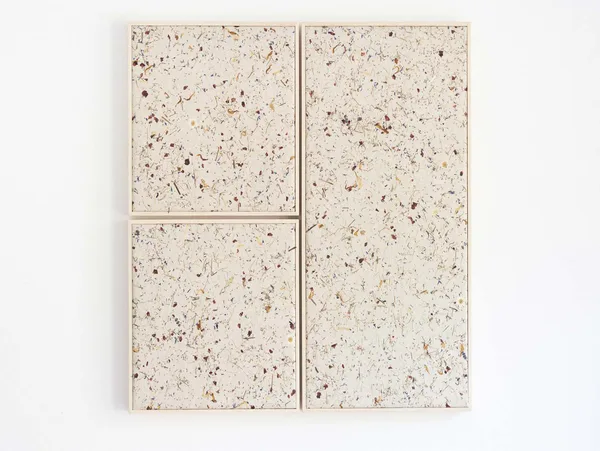 αw 1.00
Natural Acoustic
Hemp Absorber with Flax Fleece
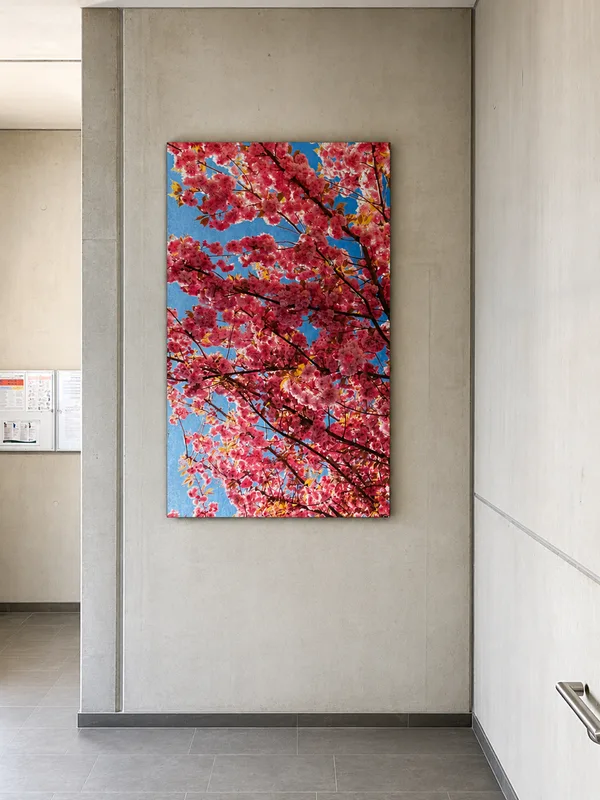 αw 1.00EPD
SilentFiber
SilentPICTURE Acoustic Picture
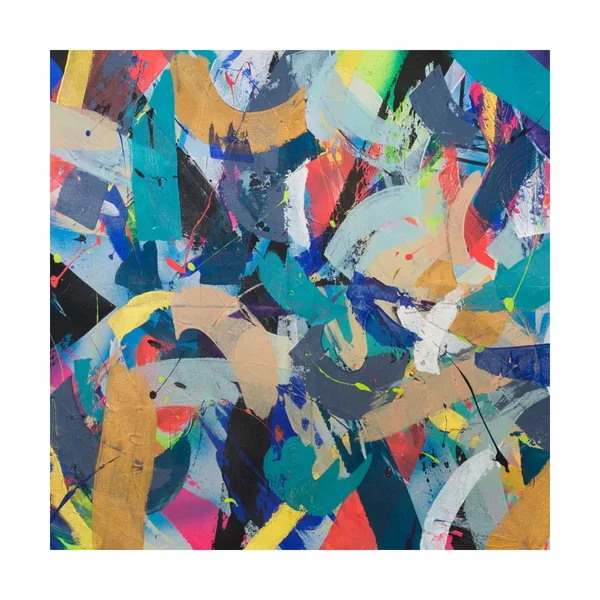 αw 0.95
MW Acoustics
Acoustic Pictures
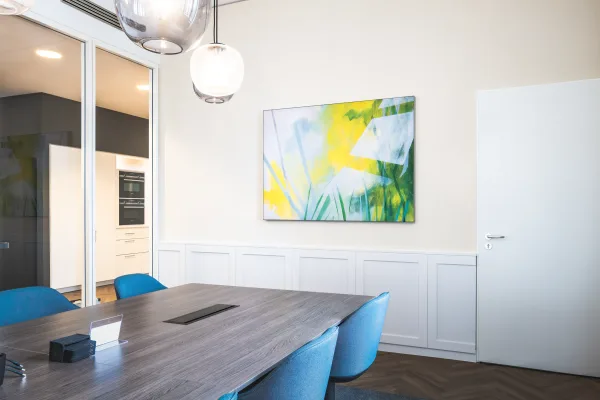 αw 0.90
freiraum Akustik
Acoustic Picture Art Motifs
 αw 0.90
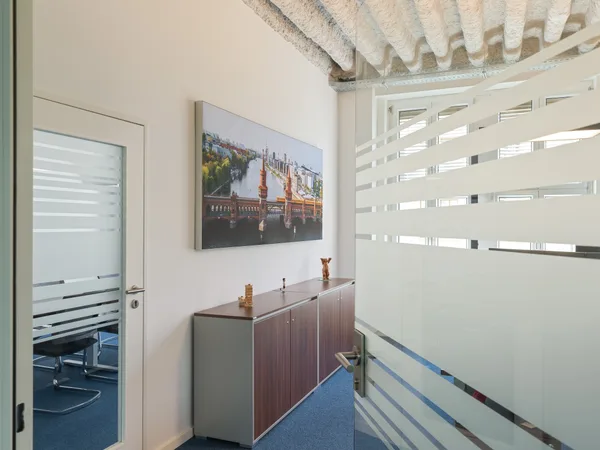
freiraum Akustik
Acoustic Picture City Motifs
 αw 0.90
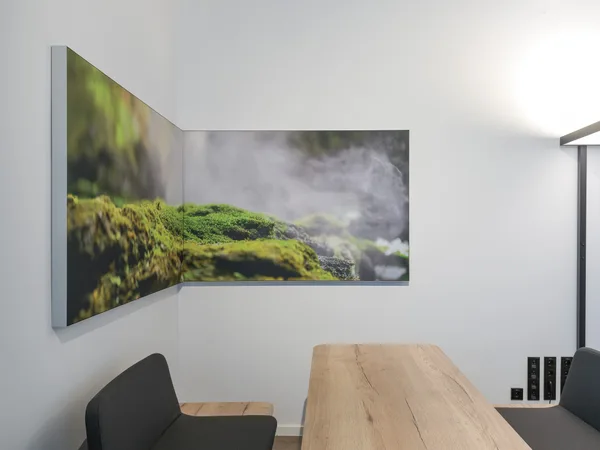
freiraum Akustik
Acoustic Picture Nature Motifs
 αw 0.90
freiraum Akustik
Acoustic Picture Your Motif
 αw 0.90
freiraum Akustik
Monochrome Acoustic Pictures, All Formats
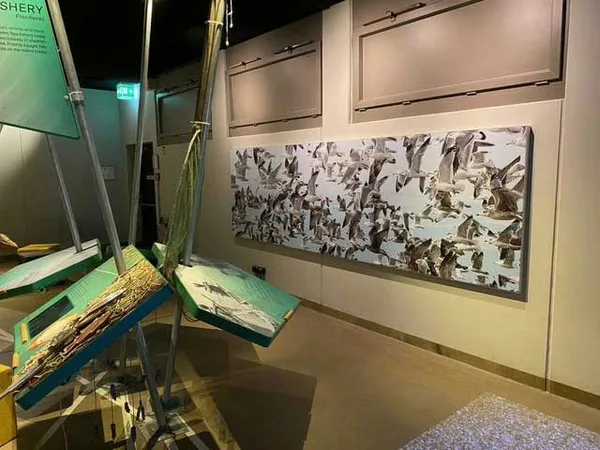 αw 0.90
raumAKUSTIKS
raumAKUSTIKS Acoustic Picture
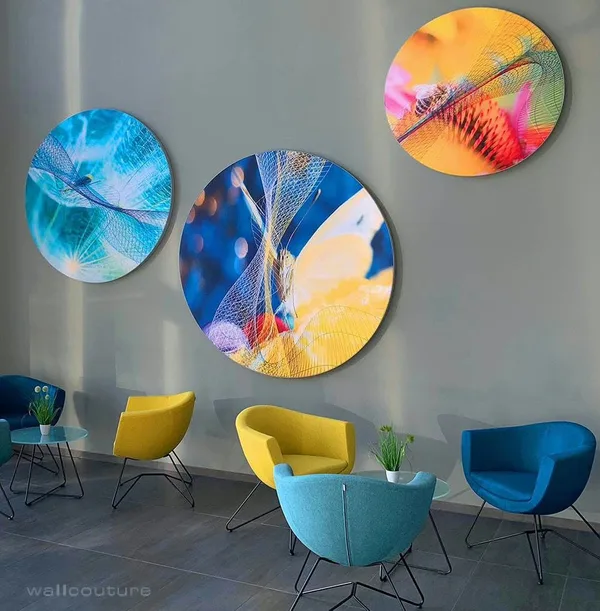 αw 0.90
raumAKUSTIKS
raumAKUSTIKS Round Wall Absorber
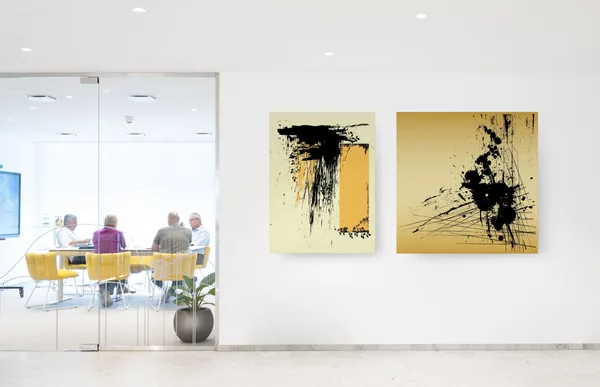 αw 0.90
SCHALLSAUGER (KASPER GmbH)
Schallsauger FRAMELESS PICTURE
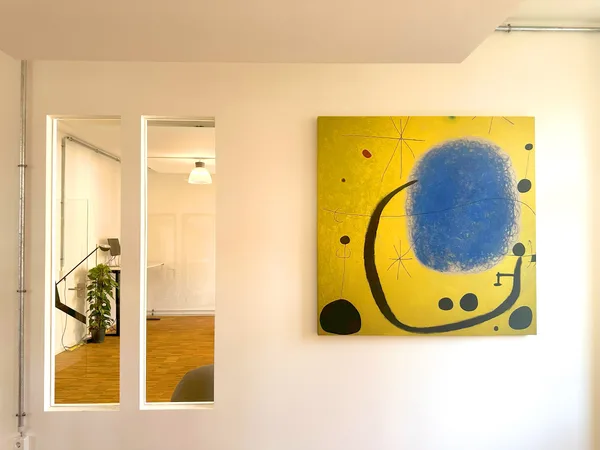 αw 0.85
raumton
raumton Acoustic picture
Acoustic wall art, plain wall absorber and ceiling raft compared
| Absorption | Appearance | Mounting | Best for | |
|---|---|---|---|---|
| Acoustic wall art (printed, with core) | αw roughly 0.6 to 0.9, depending on core and thickness | Looks like a picture, free choice of motif | Wall-mounted like a picture, low weight | Living rooms, meetings, practices, restaurants |
| Plain wall absorber | αw up to 1.0, same physics without a fabric compromise | Visible as an acoustic element, fabric or fleece face | Wall-mounted, partly larger formats | Offices, studios, when looks are secondary |
| Ceiling raft | Absorbs on both faces, rated by area A per element | Overhead, keeps the walls free | Suspended from the ceiling | Rooms with full walls or little wall area |
How acoustic wall art works
Behind the motif sits a porous absorber: open-cell melamine resin foam or compressed PET fleece. Incident sound passes through the air-permeable fabric into the core, the air rubs inside the pores and the sound energy is converted into heat. The physics is the same as for any porous wall absorber: more thickness means more effect, especially towards lower frequencies.
The condition is the fabric: it must stay air-permeable, otherwise the surface reflects before the core can work. Common acoustic fabrics are printed with UV direct or dye-sublimation printing and remain open-pored. A primed or painted canvas, by contrast, is largely airtight; a stretched-canvas print without an absorber core is decoration, not an absorber.
How to recognise an effective acoustic picture
Three pieces of information separate effective products from printed decoration. First, the core material and thickness: 40 to 50 mm of porous core is the usual working range; below 30 mm little remains for room acoustics. Second, a measurement to ISO 354 with the weighted absorption coefficient αw and its class. Third, the mounting used in the test, because a small air gap improves low-frequency performance and changes the measured value.
Without these, the effect cannot be judged or used in a reverberation-time calculation. The Acoustic Index catalogue stores per-band values for each product, so printed panels can be planned like any other absorber.
How many panels does my room need?
The number follows from the missing equivalent absorption area, not from taste. As a rule of thumb for a reverberant living or meeting room: starting reverberation time around 0.8 s, target around 0.55 s. By Sabine, roughly 0.09 m² of absorption area is then missing per cubic metre of room volume. For a room of 20 m² with a 2.5 m ceiling that is about 4.5 m²; at a panel format of 1.2 × 0.9 m and αw 0.8 that corresponds to five to six panels.
The estimator at the top of this page runs this calculation live for your room size. For a robust design with DIN 18041 targets and real product data, the reverberation calculator does the full computation.
Placement: first reflections first
Absorbers do the most where sound arrives concentrated. In meeting and living rooms that is the wall area at ear height between the talking positions, and large parallel hard surfaces between which flutter echoes build up. Two medium panels on opposite walls therefore often beat one large panel on a side wall.
Printed acoustic panels do not compete with the furnishing: they occupy exactly the surfaces that were meant for pictures anyway. Where the walls are full, ceiling rafts add absorption overhead.
Motif, format and fabric
Printing is done on air-permeable polyester acoustic fabrics, either your own photo-quality motifs or the manufacturers' motif series. Common formats range from 60 × 60 cm up to about 200 × 120 cm, and many suppliers produce custom sizes. For commercial rooms, check the fire class of the complete build-up; flame-retardant materials are frequently required.
The motif itself is acoustically neutral as long as the fabric stays open-pored. What decides is the build-up behind it, so every product decision should rest on the measurement values, not the preview image.
Limits: what acoustic wall art cannot do
An acoustic picture improves the acoustics of the room it hangs in. It does not insulate sound towards the neighbour (that is sound insulation, a property of the wall), and with a 40 to 50 mm core it absorbs very little deep bass. Low-frequency problems need thicker builds or resonators.
Used realistically, printed acoustic panels are mid- and high-frequency absorbers with living-room manners: exactly the band where speech, chatter and the reverberance people find unpleasant live.
Frequently asked questions
What is acoustic wall art?
A sound absorber in picture form: a porous core of melamine resin foam or PET fleece (usually 40 to 50 mm), covered with an air-permeable, printed acoustic fabric. It hangs like a picture and absorbs reverberation in the room, mainly in the speech range.
How effective is printed acoustic art really?
With a real absorber core, printed panels reach weighted absorption coefficients of roughly 0.6 to 0.9, depending on core material, thickness and air gap. That puts them in the same league as plain wall absorbers. Without a core, as a printed stretched canvas, the effect is close to zero.
Does the print change the absorption?
Barely, as long as the fabric stays air-permeable. UV direct and dye-sublimation printing on acoustic fabrics largely preserve the open pores. Densely coated or painted surfaces are the problem: they reflect the sound before it reaches the core.
How many acoustic pictures do I need for 20 m²?
As a rule of thumb for a reverberant living or meeting room (target: from about 0.8 s down to 0.55 s): around 4 to 5 m² of absorber area, i.e. five to six panels of 1.2 × 0.9 m at αw 0.8. The estimator on this page computes this for your room size; the reverberation calculator does the precise design.
Where should I hang acoustic panels?
At ear height on the walls between the talking and seating positions, and on large parallel hard surfaces between which flutter echoes occur. Two panels on opposite walls often work better than one large panel on a side wall.
Does acoustic wall art help against noise from neighbours?
No. Printed acoustic panels absorb reverberation inside your own room (sound absorption). They leave sound transmission through walls or ceilings (sound insulation, R'w) practically unchanged. That requires heavy, dense, decoupled constructions.
Is a printed canvas without a core a sound absorber?
No. A primed or painted canvas is largely airtight and has no meaningful absorption. The effect of an acoustic picture is created in the porous core behind the fabric. Without a core and without an ISO 354 measurement it is decoration.
What data should a supplier provide?
Core material and thickness, the weighted absorption coefficient αw with its class from an ISO 354 measurement, the mounting used in the test and ideally the absorption values per frequency band. Without these, the product cannot seriously be used in a room design.
Compare acoustic art panels with measurement data
Compare printed acoustic panels in the catalogue by absorption coefficient, format and build-up, with stored per-band values.
Acoustic wall art in search