
Acoustic tiles and boards: materials, values, selection
Acoustic tiles and boards are flat sound absorbers for ceilings and walls: mineral wool tiles, wood wool boards, perforated gypsum boards and PET felt panels. They differ less in principle (all work as porous or perforated absorbers) than in absorption, fire class, robustness and looks. Mineral wool leads with αw up to 1.0; wood wool and gypsum sit below depending on the build-up, but win on robustness and design.
This page compares the four families with typical values, shows live measured absorption curves from the catalogue, and explains which data a datasheet must contain for tiles to be compared seriously.
Last updated: 9 July 2026
- mineral wool tiles, class A
- αw up to 1.00
- mineral wool, wood wool, gypsum, PET
- 4 families
- ceiling test mounting (e.g. E-200)
- Type E
- the standard behind every αw
- ISO 354
Live from the catalogue
Board materials across frequency
Median ISO 354 absorption of all published products per material family. Updates with the catalogue.
| Hz | 125 | 250 | 500 | 1000 | 2000 | 4000 |
|---|---|---|---|---|---|---|
| Mineral wool (median) | 0.34 | 0.46 | 0.71 | 0.85 | 0.87 | 0.86 |
| Wood/wood wool (median) | 0.20 | 0.55 | 0.80 | 0.85 | 0.83 | 0.71 |
| Perforated gypsum (median) | 0.23 | 0.44 | 0.59 | 0.55 | 0.44 | 0.39 |
Median per octave band from the stored reverberation-room measurements. Sample: 359 mineral wool, 288 wood and 238 gypsum products. For a design, the measurement of the actual product in its actual mounting counts.
Acoustic tiles with measurement data
Published board products with stored ISO 354 measurements, sorted by absorption coefficient.
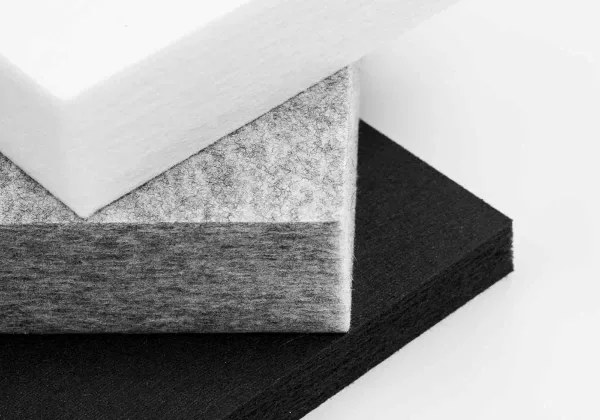 αw 1.00
BK Raumakustik
aPerf® pad
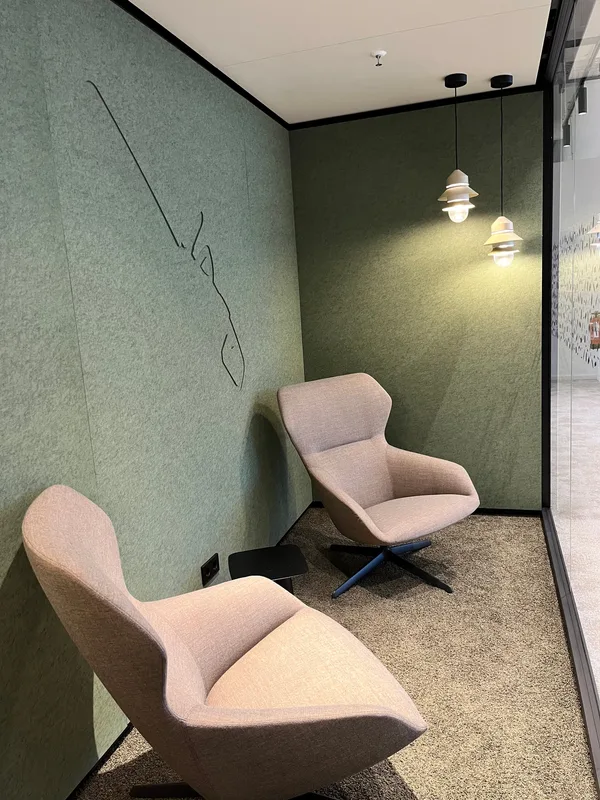 αw 1.00
BK Raumakustik
aPerf® panel
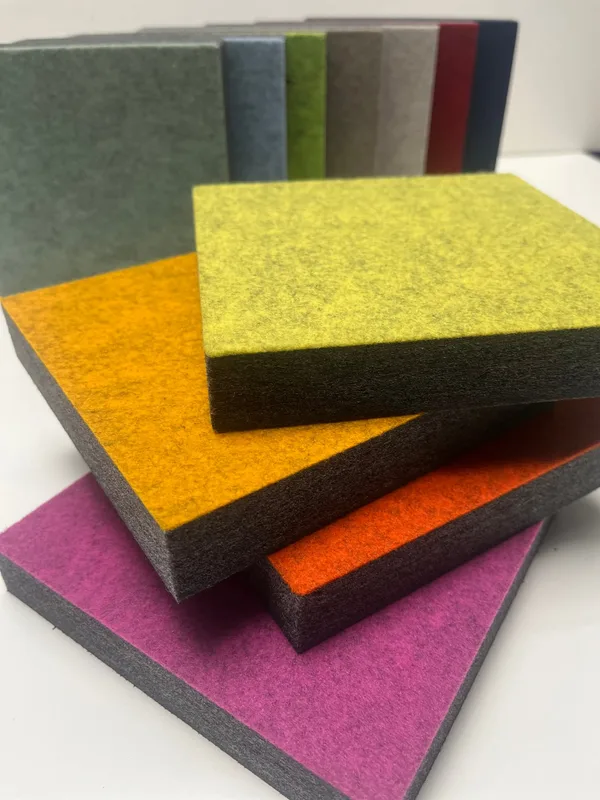 αw 1.00
BK Raumakustik
aPerf® panel colour
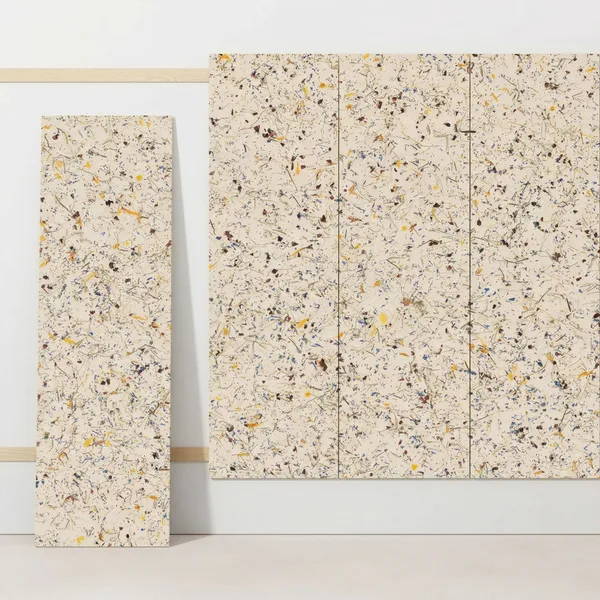 αw 1.00
ORGANOID
ORGANOID Acoustic Panel Modular
 αw 1.00EPD
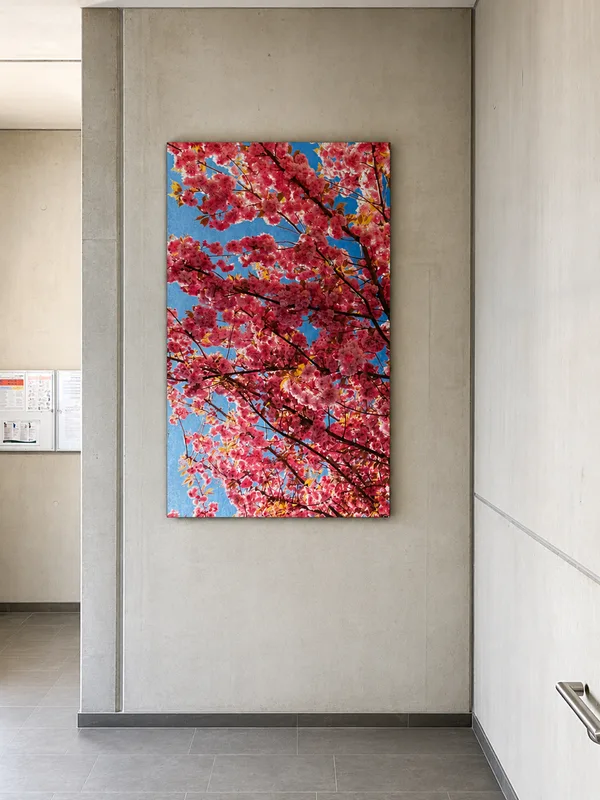
SilentFiber
SilentPICTURE Acoustic Picture
 αw 1.00
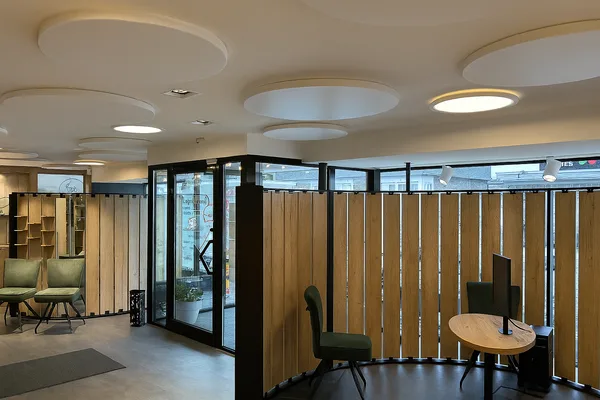
Silentrooms GmbH & Co. KG
Silentrooms Ceiling Absorber
 αw 1.00EPD
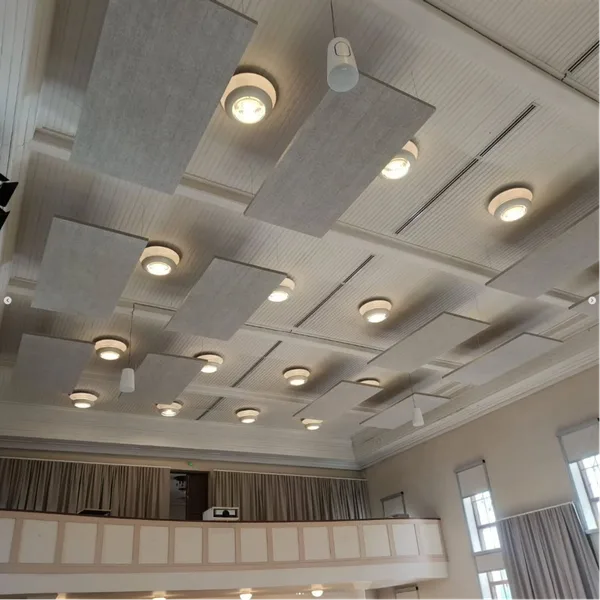
SilentFiber
SilentRoot cloud Acoustic Ceiling Sail
 αw 1.00EPD
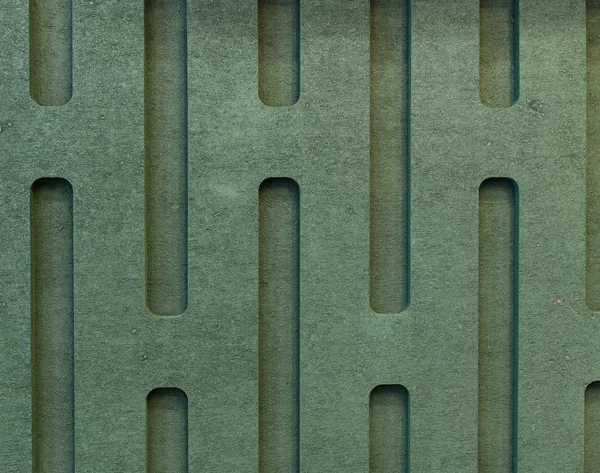
SilentFiber
SilentRoot Torf Acoustic Panel
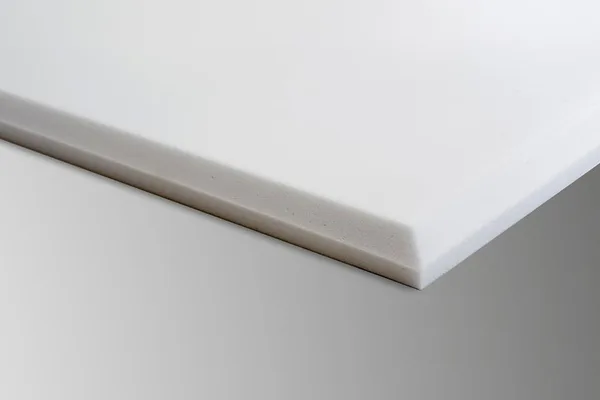 αw 1.00
SONATECH GmbH + Co. KG
SONATECH Baso Decor
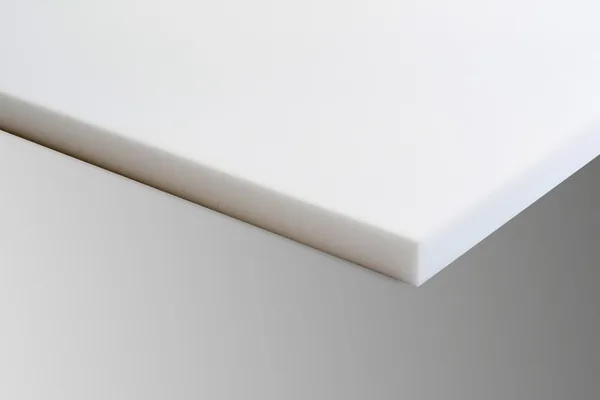 αw 1.00
SONATECH GmbH + Co. KG
SONATECH Baso Plan
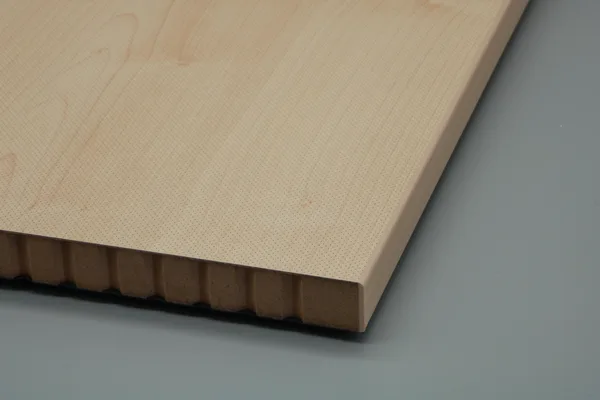 αw 0.95
BVS Akustik
AKUSTIbohr nano Laser Acoustic Panel
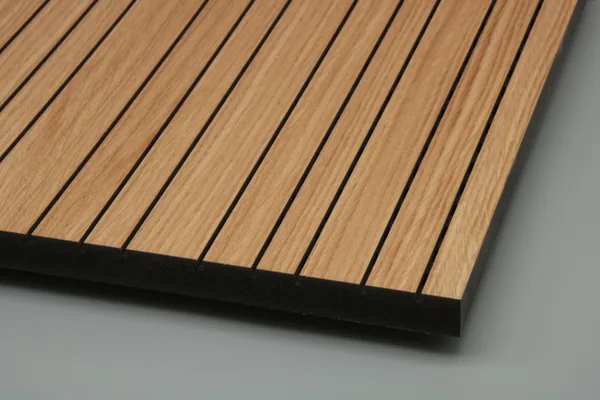 αw 0.95
BVS Akustik
AKUSTIpan SL Acoustic Panel
The four material families of acoustic tiles compared
| Typical αw | Fire behaviour | Strengths | Typical use | |
|---|---|---|---|---|
| Mineral wool tile | 0.90 to 1.00 (class A is common) | A1/A2 (non-combustible) | Highest absorption per mm, light, economical | Grid ceilings, offices, schools, clinics |
| Wood wool board | 0.40 to 0.90, per thickness and cavity/backing | Usually B-s1,d0, mineral-bonded up to A2 | Robust, impact-resistant, distinctive texture | Sports halls, schools, parking, exposed areas |
| Perforated gypsum board | 0.40 to 0.70, per perforation and cavity | A2 (non-combustible) | Seamless, skimmable, free design | Design ceilings, foyers, premium fit-out |
| PET felt panel | 0.45 to 0.85, per thickness and air gap | Usually B/C-s1,d0 (flame-retardant) | Light, coloured, printable and millable | Wall absorbers, screens, ceiling rafts |
Two working principles, four materials
Acoustically, tiles work by two principles. Porous boards (mineral wool, PET felt, wood wool) let sound enter the material and convert it into heat through friction; their effect grows with thickness and air gap. Perforated boards (gypsum, wood, metal) act as perforated absorbers: the holes form a resonating air system with the cavity behind, and the absorption maximum can be tuned via open area and cavity depth.
In practice: porous boards are more broadband and hard to beat in the mid/high range; perforated boards, with the right cavity, also reach mid and lower frequencies while offering a closed, robust surface. Many systems combine both, for example perforated boards with an acoustic fleece and mineral wool in the cavity.
What the datasheet must contain
Tiles only become comparable with four pieces of data: the weighted absorption coefficient αw with its class from an ISO 354 reverberation-room measurement, the mounting used in the test (direct or with a defined cavity; for ceilings type E with a millimetre figure, e.g. E-200), the absorption values per frequency band, and the fire class per EN 13501-1. An αw without the mounting is worth little, because the same build-up can measure completely differently mounted directly versus suspended.
Watch out for two patterns: NRC values from the US run systematically somewhat higher than αw and are not directly comparable. And absorption coefficients above 1.0 as a product promise are unserious; ISO 11654 caps αw at 1.0, and raw αs values exceed 1 only due to edge diffraction in the test.
Live from the catalogue: materials across frequency
The chart at the top of this page shows median absorption curves of the board materials from the Acoustic Index catalogue, computed from the stored ISO 354 measurements of the listed products. The typical pattern becomes visible: mineral wool reaches high values early and holds them across the spectrum, wood wool and gypsum join later and stay below depending on the build-up.
The median is a deliberate choice: it is robust against outliers and shows what a typical product of the family delivers. For designing an actual room, the measurement of the actual product in its actual mounting still decides; exactly those are stored per product in the catalogue.
Ceiling or wall: where the board goes
Most acoustic tiles end up on the ceiling, as lay-in tiles in a grid or glued/suspended over the full area. That is usually right, because the ceiling is the largest free surface. Wall mounting pays off additionally against flutter echoes between parallel hard walls and in rooms whose ceiling is unavailable, for example with concrete-core activation.
Design is a further reason for the wall: PET felt and printable boards turn the absorber area into a design element. Mechanically stressed areas (sports halls, corridors, parking) are the home of the wood wool board, the only family regularly available impact-resistant.
Specification and proof
For specification, the values belong in the text per build-up: board type and thickness, mounting including cavity, required absorber class or αw per octave band, fire class, plus impact resistance or humidity suitability where relevant. Proof runs through the reverberation-room test report; serious manufacturers provide it on request or link it directly.
In the Acoustic Index catalogue, measurement data is stored and filterable per product and build-up, including fire class and EPD availability. A board shortlist can be narrowed to the requirement in minutes and checked directly against the room's target in the reverberation calculator.
Frequently asked questions
Which acoustic tiles absorb best?
Per millimetre of build-up, mineral wool leads: common ceiling tiles reach αw 0.90 to 1.00 (class A). Wood wool boards and perforated gypsum sit at 0.40 to 0.90 depending on the build-up, offering more robust or seamless surfaces in return. What counts is the measured value of the actual product in its actual mounting.
What is the difference between porous and perforated boards?
Porous boards (mineral wool, PET, wood wool) absorb inside the material and are broadband. Perforated boards (gypsum, wood, metal) act together with the cavity as a tuned system and can be designed for specific frequency ranges via open area and cavity depth, with a closed, robust surface.
What does the mounting type mean for the measured values?
The αw applies only to the tested build-up. Ceiling tiles are measured to ISO 354 in mounting type E with a defined cavity, stated in millimetres (E-200 = 200 mm to the slab). An E-400 value cannot be transferred to a directly glued installation; the cavity mainly improves low frequencies.
Are acoustic tiles non-combustible?
Mineral wool and gypsum tiles usually are (A1/A2). Wood wool boards mostly reach B-s1,d0, mineral-bonded versions up to A2. PET felt is usually B to C (flame-retardant). Escape routes and many public areas require A classes; the class is on the datasheet and filterable in the catalogue.
What does good room acoustics with tiles cost?
The range is wide and depends on material, surface and installation. A different calculation helps for orientation: a tile with αw 0.9 needs only two thirds of the area of a tile with αw 0.6 for the same effect. A higher-grade product can therefore be cheaper per square metre of effect than the nominally cheaper one.
NRC or αw: which figure counts?
In Europe αw per ISO 11654, derived from an ISO 354 reverberation-room measurement. The US figure NRC averages differently and runs systematically somewhat higher; the two are not directly comparable. Most robust for planning are the per-octave absorption values from which both single numbers derive.
Can I lay acoustic tiles into an existing grid ceiling?
Yes, that is the easiest retrofit: swap existing lay-in tiles for absorbing mineral wool tiles in the same module. The substructure stays, and the effect corresponds to the new tile's measured value at the existing suspension depth.
Which boards suit sports halls?
Wood wool boards are the standard: robust, tested impact-resistant versions available, with αw up to about 0.90 depending on the build-up. Mineral wool tiles absorb more but need mechanical protection in ball-impact areas, such as a perforated metal or grid cover.
Compare acoustic tiles with real measurements
All boards in the catalogue with ISO 354 data per frequency band, filterable by αw, material, fire class and EPD.
Acoustic tiles in search