
Product update
Depth and mounting: search now knows the installation situation
You have 40 mm above the ceiling, the convincing measurement needs 200. Search now filters by build-up depth and mounting type, down to the individual measurement.
An absorber behaves differently depending on whether it sits flat on the wall or hangs 200 mm below the ceiling. The cavity shifts the effect towards lower frequencies, and every figure applies to exactly the build-up it was measured in. On site the question runs the other way round: there are 40 mm above the ceiling, and in a listed building nothing may be suspended at all. What is left?
That is now a filter. The installation section in search has three controls: a maximum height including build-up between 20 and 400 mm, the five mounting types direct, with cavity, suspended, free-hanging and object, plus the mounting surface.
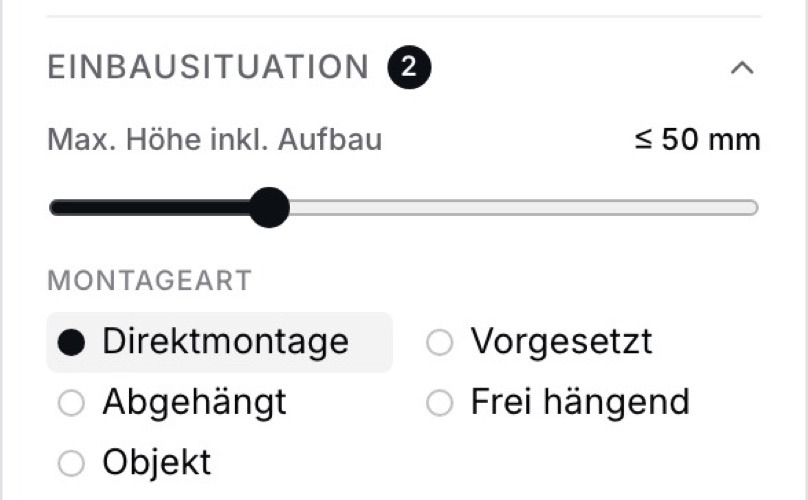
What matters is where the filter bites. It works on the individual measurement, not on the product. Depth, mounting type, αw range and frequency thresholds all have to be met by the same measured variant. A product that reaches αw 1.00 in one measurement and builds up 20 mm thin in another will not show up for the combination of αw from 0.9 and 25 mm at most. Both claims are true, they are simply not true together.
Behind it sits a machine-readable breakdown of every measured variant: material thickness, air gap, total build-up, mounting type and, where available, the axis spacing. Nearly every ISO 354 variant of the purchasable products carries it, for the most part backed by a data sheet or test report, every value with its source.
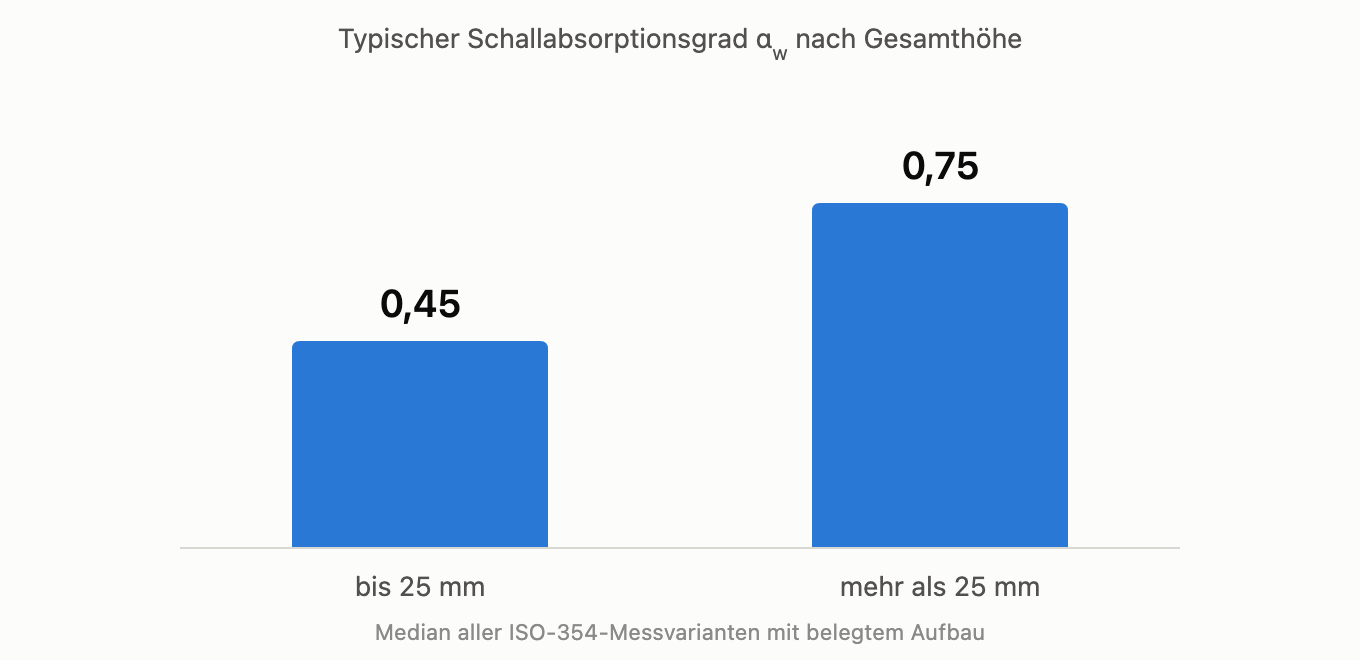
The catalogue confirms the rule of thumb: shallow set-ups of up to 25 mm typically reach an αw around 0.45, with more height the norm sits at 0.75. Beyond that, extra height barely lifts the αw any further, it mostly shifts the effect towards low frequencies. So when choosing, what matters is less the best value on the data sheet than what fits the height you actually have.
The result card keeps up: with the filter active it shows the αw range of the variants that meet your limit, not the best values of the whole product. The PTB reference materials take part as well: for a large share, the total height is derived from the structured fields of the PTB database. Where thickness or distance is missing or ambiguous there, the entry stays out of depth-capped results, because an unknown depth is not a match. Object absorbers whose measurement only reports the object-related absorption area do take part, provided their total height is documented; combine the filter with αw or frequency thresholds and they drop out, because their measurement does not back those figures. Only what verifiably meets your constraint is shown.
No account needed.
Filter by installation situation