
Manufacturer
BVS Akustik
BVS Akustik GmbH & Co. KG from Verl (East Westphalia) has been active in the furniture industry since 1990 and produces custom acoustic panels with CNC saws, purpose-built drilling lines and an in-house laser system. Almost all board materials are processed: solid wood, veneered, composite and decor boards, each cut, edge-finished and lacquered to the customer's specification. The range covers drilled (AKUSTIbohr), micro-perforated (AKUSTIpur), slotted (AKUSTIpan) and sound-absorbing partition elements (AKUSTItrenn), each in numerous hole patterns and build-up depths. The elements are available in fire classes B1 and B2 and, for sports halls, with certified ball-impact resistance. References include Princeton University, NYU and the Emser Therme.
AKUSTItrenn Acoustic Partition
AKUSTItrenn
Description
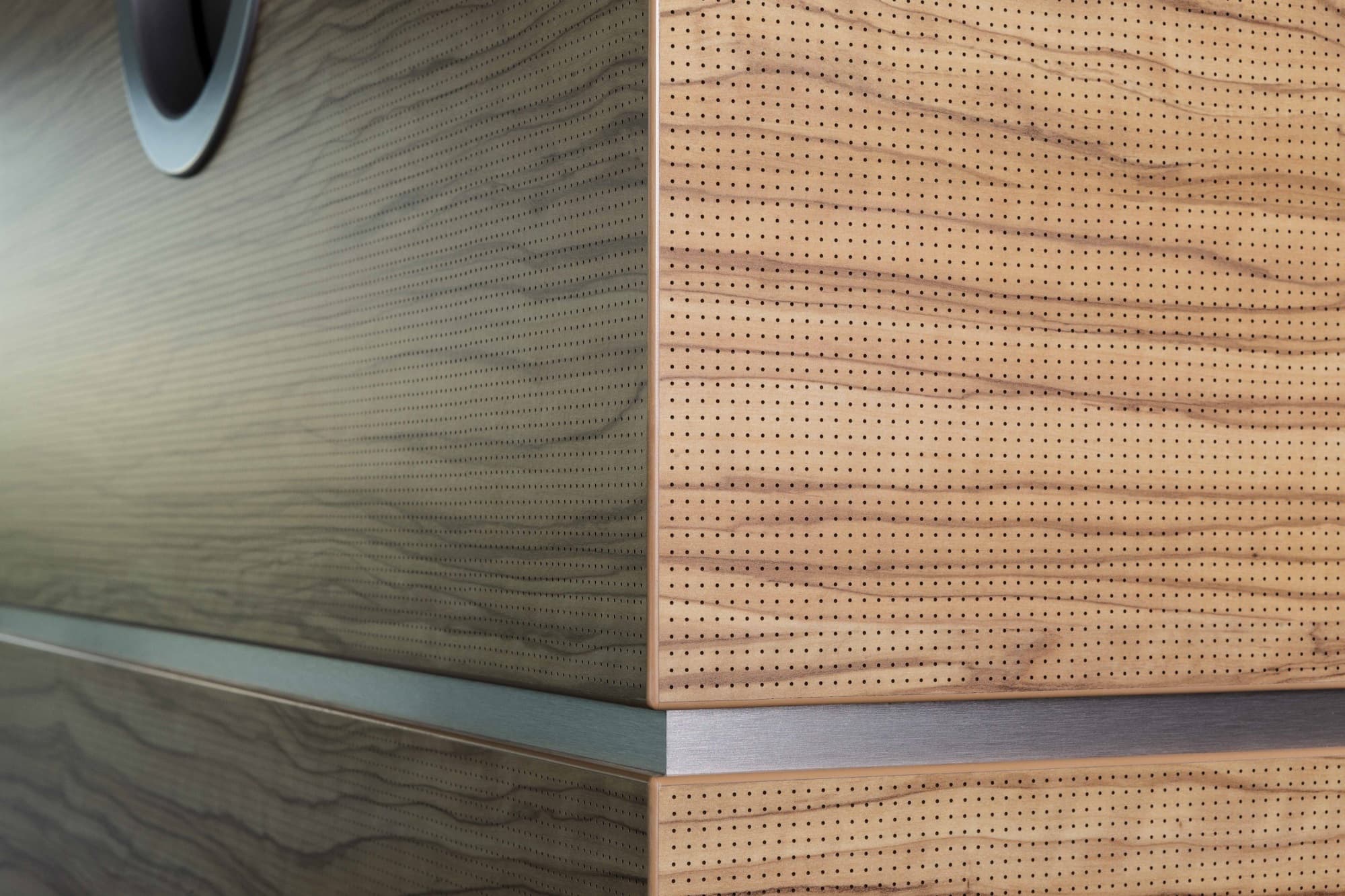
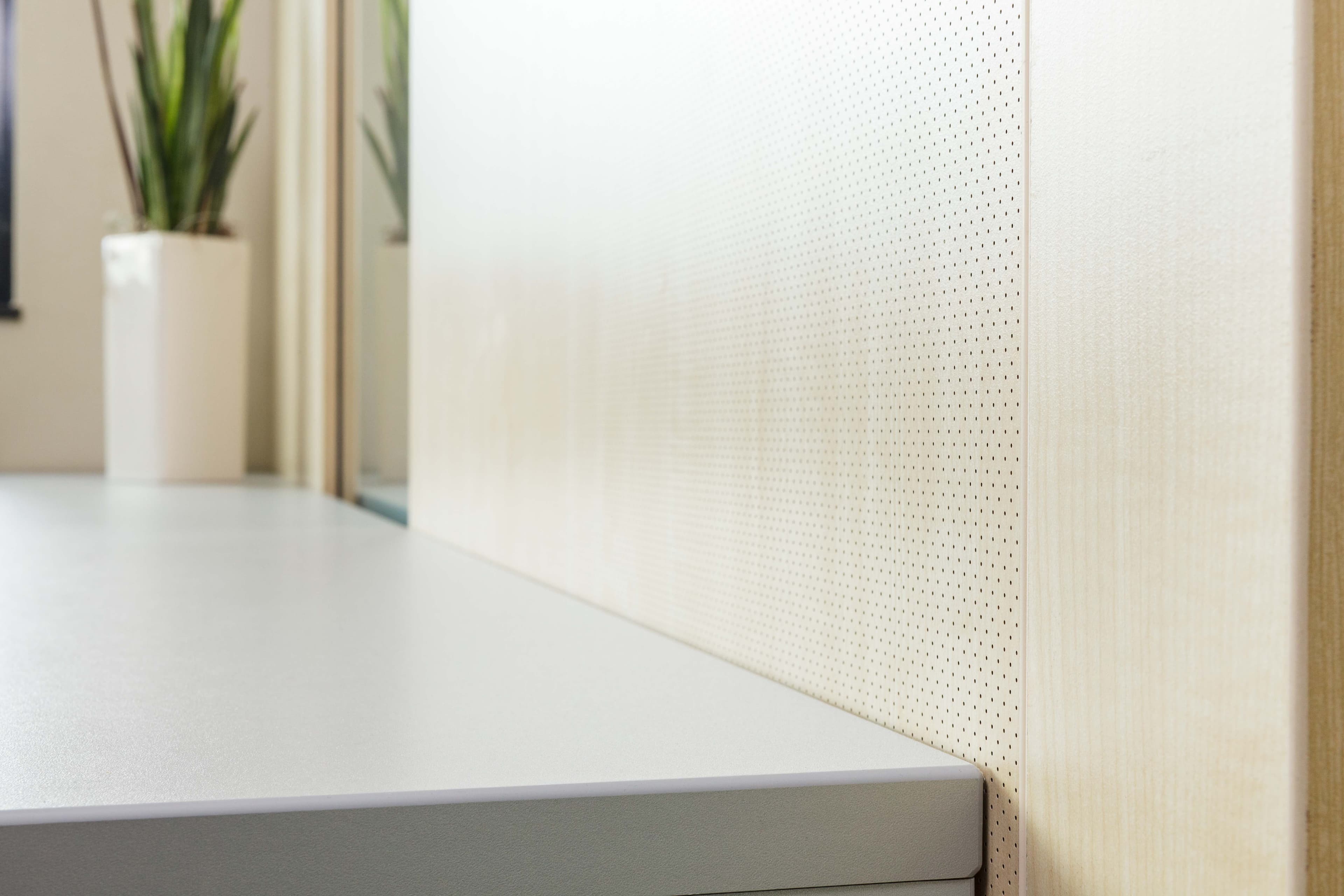
AKUSTItrenn is a partition and screen element from BVS, micro-perforated on both sides, made from a double-sided acoustic wood-fibre insulation board with an integrated insulation layer. The visually calm micro-perforation on both sides is produced with hole diameters of 1 mm (standard) through 1.5 and 2 to 2.5 mm as well as grids from 4 to 8 mm and a staggered 6/3 mm grid. The integrated insulation layer removes the need to build up multi-layer partitions by hand; direct edge banding produces high-quality components with predictable absorption values. The edge-free perforation allows precise cuts for demanding geometries and the integration of glazing, doors, switches and other components, while reinforced edge sections for fittings as well as cuts and cut-outs are possible directly on site. The entire panel build-up is bonded formaldehyde-free to the NAF standard and is therefore low in emissions. Elements are produced up to 3010 mm in length and 1300 mm in width with margin widths to order and are suited to fixed and mobile interior fit-out as well as exhibition construction. Acoustically, AKUSTItrenn works through the interplay of the micro-perforation on both sides with the wood-fibre insulation behind it, which damps the sound inside the element and keeps both sides of the room absorbent. The sound absorption coefficient is determined in the reverberation room per EN ISO 354 and rated per EN ISO 11654; for design work the full third-octave curve matters alongside the single-number rating. In addition, the sound insulation of the element is documented as the weighted sound reduction index Rw per EN ISO 10140-2, so the component addresses both the reverberation time in the room and sound transmission between the separated areas.
Technical data
Measurement data
Sound absorption
Reverberation chamber (ASTM C423 / ISO 354)· 10 variants
Choose perforation
Frequency values
αp per octave band
| f (Hz) | 125 | 250 | 500 | 1k | 2k | 4k |
|---|---|---|---|---|---|---|
| αp | 0.30 | 0.45 | 0.65 | 0.80 | 0.95 | 0.85 |
Create a permanent free account — Access frequency bands, variants and export.
Free. No password required.
| Compare | Value | |
|---|---|---|
| h=2 in · without insulation | NRC0.75 | |
| Free-standing screen · effective on both sides | NRC0.65 |
Test report: 1502-002-14
NRC: 0.75 (derived from ISO 354 lab data)
Institute: SG-Bauakustik, Institute for Acoustic Product Optimisation
Measurement date: 2014-06-18
Perforation: 1/4/4/P · 4,91 %
Measured values as a table (10 measurements)
| Build-up | NRC | 100 Hz | 125 Hz | 160 Hz | 200 Hz | 250 Hz | 315 Hz | 400 Hz | 500 Hz | 630 Hz | 800 Hz | 1000 Hz | 1250 Hz | 1600 Hz | 2000 Hz | 2500 Hz | 3150 Hz | 4000 Hz | 5000 Hz |
|---|---|---|---|---|---|---|---|---|---|---|---|---|---|---|---|---|---|---|---|
| 1/4/4/P · 4,91 % · h=50 mm · without insulation | 0.75 | 0.30 | 0.31 | 0.35 | 0.36 | 0.44 | 0.51 | 0.56 | 0.69 | 0.73 | 0.76 | 0.81 | 0.89 | 0.90 | 0.97 | 1.01 | 0.91 | 0.84 | 0.86 |
| 1/4/4/P · 4,91 % · Free-standing screen · effective on both sides | 0.65 | 0.23 | 0.26 | 0.28 | 0.35 | 0.40 | 0.43 | 0.54 | 0.59 | 0.62 | 0.64 | 0.69 | 0.80 | 0.88 | 0.95 | 0.93 | 0.88 | 0.82 | 0.80 |
| 1/4,8/4,8/P · 2,76 % · h=50 mm · without insulation | 0.60 | 0.23 | 0.27 | 0.29 | 0.32 | 0.40 | 0.46 | 0.50 | 0.52 | 0.59 | 0.60 | 0.68 | 0.73 | 0.88 | 0.86 | 0.86 | 0.81 | 0.74 | 0.76 |
| 1/4,8/4,8/P · 2,76 % · Free-standing screen · effective on both sides | 0.55 | 0.15 | 0.21 | 0.26 | 0.27 | 0.31 | 0.34 | 0.45 | 0.47 | 0.52 | 0.53 | 0.56 | 0.58 | 0.72 | 0.79 | 0.77 | 0.76 | 0.71 | 0.69 |
| 1/6/3/V · 3,76 % · h=50 mm · without insulation | 0.70 | 0.25 | 0.26 | 0.30 | 0.38 | 0.40 | 0.41 | 0.51 | 0.60 | 0.71 | 0.72 | 0.77 | 0.87 | 0.96 | 0.98 | 0.92 | 0.85 | 0.81 | 0.83 |
| 1/6/3/V · 3,76 % · Free-standing screen · effective on both sides | 0.60 | 0.15 | 0.21 | 0.28 | 0.29 | 0.35 | 0.39 | 0.48 | 0.54 | 0.57 | 0.59 | 0.71 | 0.73 | 0.82 | 0.89 | 0.88 | 0.85 | 0.80 | 0.76 |
| 1/6/6/P · 1,92 % · h=50 mm · without insulation | 0.55 | 0.17 | 0.24 | 0.31 | 0.34 | 0.41 | 0.44 | 0.48 | 0.51 | 0.54 | 0.53 | 0.58 | 0.60 | 0.71 | 0.73 | 0.68 | 0.65 | 0.63 | 0.67 |
| 1/6/6/P · 1,92 % · Free-standing screen · effective on both sides | 0.45 | 0.13 | 0.18 | 0.19 | 0.27 | 0.31 | 0.32 | 0.38 | 0.44 | 0.46 | 0.45 | 0.47 | 0.53 | 0.60 | 0.66 | 0.68 | 0.64 | 0.60 | 0.58 |
| 1/8/8/P · 1,23 % · h=50 mm · without insulation | 0.45 | 0.19 | 0.27 | 0.29 | 0.28 | 0.34 | 0.43 | 0.43 | 0.46 | 0.48 | 0.44 | 0.47 | 0.46 | 0.48 | 0.53 | 0.57 | 0.59 | 0.58 | 0.63 |
| 1/8/8/P · 1,23 % · Free-standing screen · effective on both sides | 0.40 | 0.16 | 0.18 | 0.19 | 0.25 | 0.27 | 0.32 | 0.36 | 0.39 | 0.38 | 0.38 | 0.37 | 0.41 | 0.43 | 0.47 | 0.53 | 0.52 | 0.53 | 0.55 |
Measured values as a table (10 measurements)
Access frequency bands, variants and export. Create a permanent free account
Last updated: